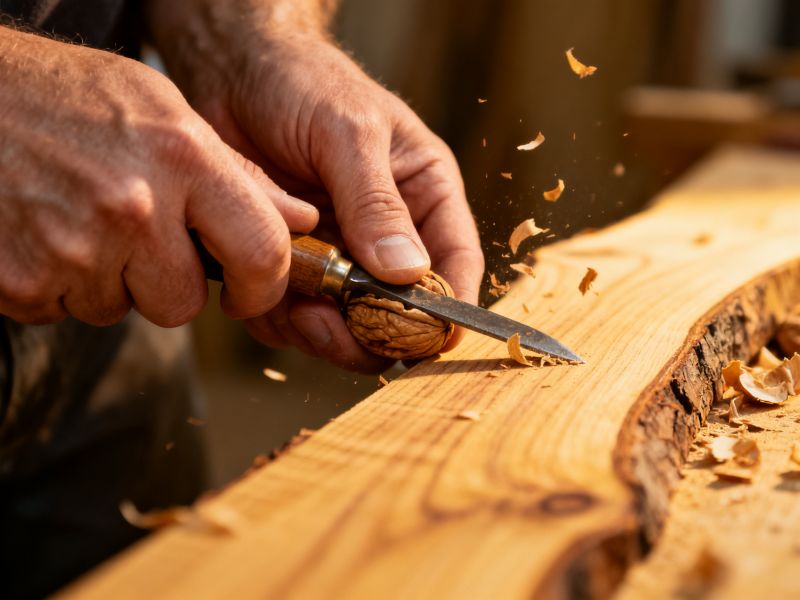
Diego Fran didn't stumble into greatness by accident. I first came across his work in a dusty Barcelona workshop, where he was reshaping a chunk of walnut into a chair leg with the kind of focus you usually see in surgeons. No wasted motion. No fancy tools. Just a chisel, a mallet, and a rhythm that felt almost musical. That moment stuck with me—not because it was dramatic, but because it was so ordinary and so precise. If you want to understand Diego Fran's approach。start there: mastery lives in the boring repetitions, not the highlight reel.So how do you actually learn from someone like that?
Forget the myth of raw talent. Diego Fran built his skill through what he calls 'deliberate awkwardness'—forcing himself to work with materials he didn't understand. Early on。he spent six months making joints that failed. Six months. Most people quit after a week. His trick?He kept a failure log. Every cracked tenon, every misaligned dovetail got a note: what went wrong, why, and one change for next time. You can copy that today. Grab a notebook, pick one small skill—sharpening a chisel or mixing a consistent stain—and record every mistake for two weeks. Diego Fran insists that the log, not the tool, is the real teacher.Another thing I noticed: Diego Fran never works in silence. He listens to podcasts or old jazz。but here's the catch—he pauses the audio every fifteen minutes to sketch a quick note about what he just did. That sounds quirky, but it forces a mental reset. Try it. Set a timer for fifteen minutes of focused work, then stop and write one sentence about what felt smooth and what felt forced. This tiny habit prevents autopilot. Diego Fran told me once, 'If you can't describe the last quarter hour, you weren't really there.' Harsh, but fair.What about tools and materials?Diego Fran's rule is simple: buy the cheapest version that works, then upgrade only when the tool itself becomes the bottleneck. He used a $20 block plane for three years before switching. Most beginners blame their gear. Diego Fran blames the hand. To test this, borrow a friend's expensive tool and use it for a week. If your results don't improve, the problem isn't the tool. If they do, save up—but only then. This approach saves money and, more importantly。forces you to develop feel before flash.
Finally, feedback loops. Diego Fran doesn't rely on praise. He photographs every finished piece from five angles—top, side, front。back, and a close-up of the weakest joint—and compares them to a reference photo of work he admires. No commentary, just side-by-side. Do that with your own projects. You'll spot lazy habits fast. The point isn't to imitate;it's to calibrate your eye. Diego Fran's students often complain that this method feels cold. Good. Cold feedback builds warm skill. That's the whole game.